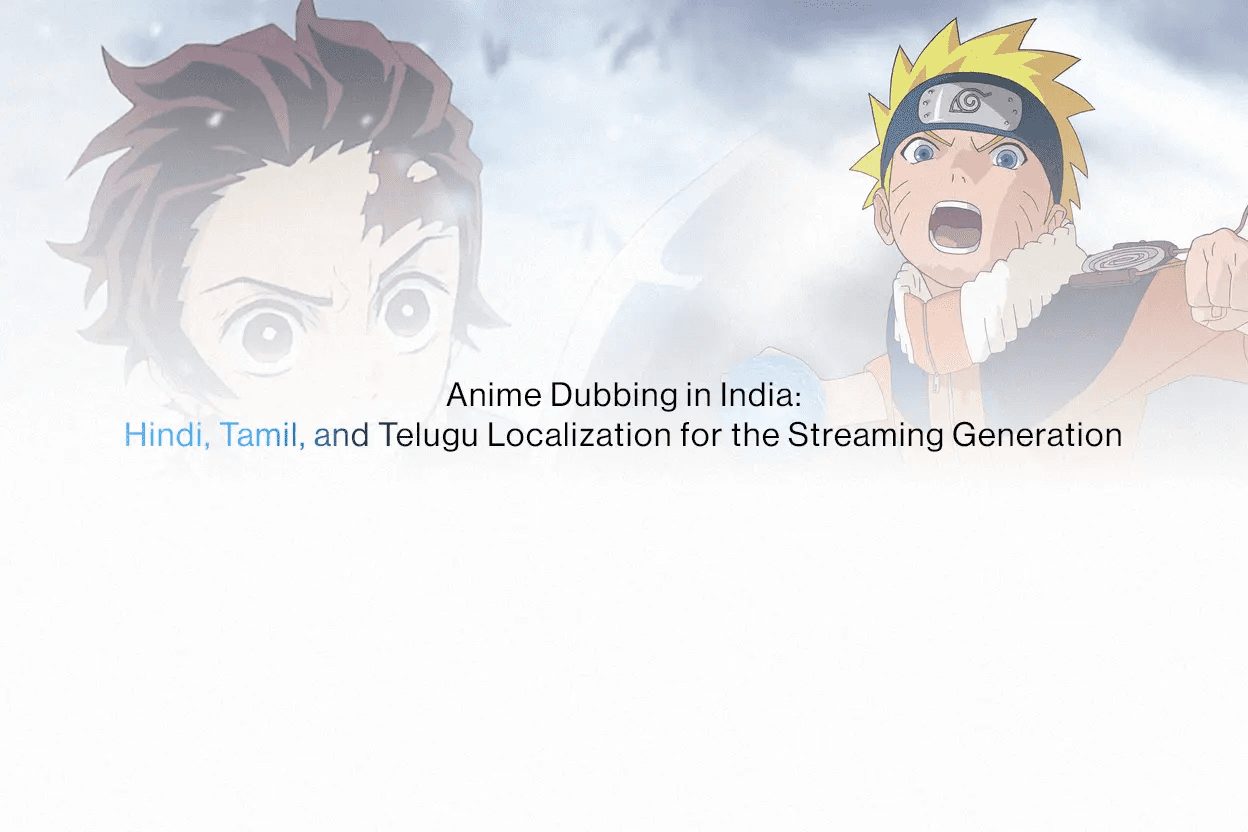
India's relationship with anime started on television. Dragon Ball Z, airing on Cartoon Network in Hindi during the early 2000s, introduced an entire generation to Japanese animation. Naruto, One Piece, Doraemon, Shin-chan, and Pokémon followed, each dubbed in Hindi, each building a community of fans who grew up hearing these characters speak their language.
That generation is now adults with smartphones and streaming subscriptions. And their appetite for anime has only grown. India ranks among the top anime-consuming countries globally by streaming viewership. Netflix, Crunchyroll, Amazon Prime, and Disney+ Hotstar all report significant Indian anime audiences. The demand for Hindi, Tamil, and Telugu anime dubbing is expanding faster than studios can supply it.
But anime dubbing is not the same as dubbing a live-action drama or a micro drama series. The vocal performance demands are different. The cultural adaptation challenges are different. The audience's expectations are different. This guide covers everything involved in dubbing anime for Indian markets, from the unique challenges of character voice casting to platform-specific requirements and the economics of anime localization.
Why Anime Dubbing Is a Distinct Discipline
Anime characters exist in a heightened emotional universe. They shout attack names. They whisper confessions that carry the weight of entire story arcs. They shift from comedic slapstick to devastating tragedy within a single scene. The Japanese voice acting tradition, seiyuu, is a specialized performing art with its own training, aesthetics, and audience expectations.
Dubbing anime into Hindi, Tamil, or Telugu requires voice artists who can match this heightened performance energy without sounding ridiculous in the target language. This is the fundamental challenge: anime vocal performances that feel natural and beloved in Japanese can sound absurd if directly replicated in Hindi. The dubbing team must find the register where anime's emotional intensity translates authentically into Indian language performance conventions.
The Vocal Range Challenge
Anime characters routinely operate across a vocal range that live-action characters never approach:
Battle sequences require sustained high-energy shouting, attack callouts, power-up screams, and combat reactions that can last 10 to 20 seconds of continuous vocal exertion. The Hindi voice artist must have the stamina and vocal technique to deliver these without straining, distorting, or losing character identity.
Emotional monologues in anime are longer, more intense, and more verbally explicit than in most live-action content. A character might deliver a two-minute speech about friendship, sacrifice, or determination that escalates from quiet conviction to full-volume declaration. The Hindi performance must sustain this emotional escalation without sounding melodramatic by Indian performance standards.
Comedic shifts happen instantly in anime. A character in the middle of a serious conversation might react to a comedic interruption with an exaggerated vocal response, a scream, a stammered protest, a deadpan observation before immediately returning to the serious conversation. The voice artist must execute these tonal shifts cleanly and quickly.
Whispered intimacy in anime romance scenes requires a vocal quality that communicates deep emotion through minimal volume. This is technically demanding, the microphone must capture nuance at very low levels, and the artist must convey emotion without the volume that normally carries it.
Not every voice artist who excels at live-action dubbing can handle anime's demands. Studios must identify and develop artists with specific anime vocal capabilities, exceptional range, stamina, comedic timing, and the ability to sustain heightened emotional states that would be considered overacting in any other context but are normal in anime.
The Performance Calibration Problem
The biggest creative challenge in anime dubbing is calibration: how much of the Japanese performance style do you preserve, and how much do you adapt for Indian audience expectations?
Too faithful to the Japanese original - replicating every vocal flourish, every extended reaction sound, every exaggerated expression - and the Hindi dub sounds like a parody. Indian audiences, even anime fans, have different tolerance thresholds for vocal exaggeration than Japanese audiences.
Too naturalized toward Indian live-action conventions - toning down the energy, removing the anime-specific vocal patterns, delivering lines as if they were from a Bollywood film, and the dub loses the quality that makes anime distinctive. It sounds like a badly acted Hindi drama rather than a properly dubbed anime.
The sweet spot is a 10 to 20 percent reduction in Japanese vocal intensity for the Hindi version. Preserve the emotional peaks and valleys of the original performance, the big moments should still feel big. But smooth the extreme edges: slightly less extended reaction sounds, slightly more natural conversational delivery in quiet scenes, slightly less vocal strain during battle sequences. The result should feel like anime, heightened, energetic, emotionally rich, performed naturally in Hindi rather than translated from Japanese.
This calibration point varies by anime genre and target audience:
Shonen anime (Dragon Ball, Naruto, My Hero Academia, One Piece) targeting teenagers can maintain more of the original Japanese energy. The audience expects and enjoys high-octane vocal performances.
Seinen anime (mature themes, complex narratives) should shift further toward naturalized Hindi performance. The audience for mature anime expects more nuanced, less stylized acting.
Kids anime (Doraemon, Shin-chan, Pokémon) should be fully adapted for Indian children, voices should sound like familiar, friendly Indian characters, not translations of Japanese ones. This is the most heavily adapted category.
Romance and slice-of-life anime should find a middle ground, preserving the gentle emotional quality of Japanese romantic voice acting while making it sound natural in Hindi. This requires voice artists with exceptional emotional subtlety, not just range and power.
Character Voice Casting for Anime
Voice casting for anime dubbing follows different principles than live-action dubbing.
Casting by Character Archetype, Not by Visual Match
In live-action dubbing, the dubbed voice must match what the viewer sees, a 30-year-old man on screen needs a 30-year-old-sounding voice. In anime, characters are drawn, not photographed. A drawn 16-year-old high school student might look 25 by realistic standards. A drawn 40-year-old might look 30.
Anime casting is based on character archetype rather than visual age:
The hot-blooded protagonist (Naruto, Goku, Midoriya) - a voice full of energy, determination, and emotional transparency. Must be able to deliver battle intensity and quiet vulnerability. The voice should sound youthful regardless of the artist's actual age.
The cool rival (Sasuke, Vegeta, Todoroki) - controlled, measured, with underlying intensity. The contrast with the protagonist's open emotion is what defines this archetype. Must sound effortlessly superior without being monotone.
The wise mentor (Kakashi, Master Roshi, All Might) - authority combined with warmth or eccentricity. Many anime mentors have comedic dimensions that the voice must accommodate alongside the gravitas.
The female lead (Sakura, Bulma, Uraraka) - strength without aggression. Modern anime heroines are capable, emotionally complex characters whose voices must communicate intelligence and determination. The historic tendency to cast anime heroines with overly cute or submissive voices is outdated and should be avoided for contemporary titles.
The villain (Frieza, Madara, Shigaraki) - menace that is compelling rather than cartoonish. The best anime villains have charisma that makes the audience understand their appeal even while opposing them. The dubbed voice must carry this complexity.
The comic relief (Zenitsu, Master Roshi, Mineta) - comedic timing and vocal elasticity. These characters often shift between extreme states, terror and courage, laziness and sudden competence, and the voice must make each shift funny rather than confusing.
The Audition Process for Anime
Anime auditions should test the specific demands of the medium:
Range test. Each candidate records the same character's line in three emotional states: calm conversation, extreme emotion (anger, joy, or fear depending on the character), and comedic reaction. The range between these states reveals whether the artist can handle anime's emotional extremes.
Sustain test. Record a sustained vocal effort, a battle cry, a power-up sequence, or an emotional monologue, lasting at least 15 seconds. Anime requires vocal endurance that casual voice work does not. Artists who strain or lose quality during sustained efforts will struggle with shonen and action anime.
Signature sound test. Every iconic anime character has a signature vocal quality, Goku's cheerful directness, Naruto's raspy determination, and Vegeta's arrogant growl. The Hindi voice does not need to imitate the Japanese signature sound, but it needs to create its own equally distinctive and memorable vocal identity. Ask candidates: "What would this character sound like if they were an Indian character?" The best answers reveal artists who think creatively about character voice rather than imitating.
Chemistry test for duo characters. Anime storytelling is built on character relationships, protagonist and rival, hero and mentor, and romantic leads. Audition potential pairs together to evaluate vocal chemistry. The voices should contrast enough to be immediately distinguishable but complement each other in shared scenes.
Building an Anime Voice Talent Roster
Studios that serve anime dubbing regularly should maintain a dedicated anime talent roster, separate from their live-action dubbing roster. Not every artist on the anime roster will also appear on the live-action roster, and vice versa.
The anime roster should include at minimum 20 to 30 artists per language with documented strengths: character archetypes they excel at (protagonist, villain, mentor, comic relief), genre strengths (shonen, romance, horror, comedy), vocal range characteristics (pitch range, maximum sustained output, recovery time between takes), and series commitment history (artists who have maintained character consistency across long-running series).
Cultural Adaptation for Indian Anime Audiences
The Honorific Decision
Japanese honorifics, san, kun, chan, sensei, senpai, and sama, pervade anime dialogue. Every interaction is colored by the honorific used. Adaptation approaches vary by target audience:
For dedicated anime fans (OTT platforms, Crunchyroll): Retain common honorifics that have entered the Indian anime fan vocabulary. Terms like sensei, senpai, and -san are widely recognized. Less common honorifics can be retained with contextual Hindi cues that communicate the relationship dynamic.
For mass-market audiences (television broadcasts, kids platforms): Fully adapt all honorifics. Sensei becomes guru-ji or teacher-ji. Senpai becomes bhaiya, didi, or senior depending on context. -San becomes a respectful Hindi address form appropriate to the character's relationship. The goal is zero friction for viewers unfamiliar with Japanese social conventions.
The consistency imperative: Whichever approach is chosen, it must be applied consistently across the entire series and across all episodes. Switching between retained Japanese honorifics and Hindi equivalents within the same series confuses viewers and breaks immersion.
Food, School, and Daily Life References
Anime is filled with Japanese daily life details, bento boxes, school festivals, cherry blossom viewing, New Year shrine visits, summer fireworks festivals, and entrance exams. These cultural touchpoints serve narrative functions: building atmosphere, revealing character, and advancing relationships.
The adaptation approach depends on the touchpoint's narrative importance:
Background cultural details (a character eating onigiri, students wearing school uniforms) can be left as-is, the visual shows the Japanese setting, and the dubbed dialogue does not need to call attention to or explain the cultural element.
Narratively important cultural elements (a school festival that serves as the setting for a romantic confession, a New Year shrine visit where characters make wishes that foreshadow the plot) need contextual adaptation. The adapter ensures that Hindi-speaking viewers understand the emotional significance of the moment even if they are unfamiliar with the specific Japanese tradition. This might involve adding a brief contextual phrase ("Iss festival mein sab apni dil ki baat kehte hain", "At this festival, everyone speaks from their heart") that communicates the moment's function without lecturing.
Humor based on Japanese cultural specifics (puns on Japanese food names, jokes about specific Japanese social conventions) must be completely replaced with Hindi humor that serves the same comedic function at the same moment in the episode.
Attack Names and Special Terminology
Anime, particularly shonen and fantasy genres, features extensive specialized vocabulary: attack names (Rasengan, Kamehameha, Detroit Smash), power system terminology (chakra, ki, quirks), character titles (Hokage, Pirate King, Symbol of Peace), and world-building terms (Devil Fruits, Titan, Breathing Techniques).
The adaptation decision for specialized terminology:
Globally iconic terms should be retained in Japanese. Kamehameha is Kamehameha in every language. Rasengan is Rasengan. These terms have transcended their Japanese origins and become universal anime vocabulary. Translating them into Hindi equivalents ("Kachua Lahar" for Kamehameha) would alienate fans and remove the iconic recognition.
Less established terms can be adapted if the Hindi equivalent sounds natural and cool. A minor attack name that has not entered global fan vocabulary can be given a Hindi name that fits the attack's visual effect and narrative context.
Power system terminology should be retained if the original Japanese term is used extensively (chakra, ki) or adapted if it describes a concept that benefits from Hindi comprehension (explaining "quirks" as "shaktiyan" or "powers" helps viewers understand the power system faster).
The guiding principle: when in doubt, retain the Japanese term. Anime fans expect Japanese terminology. Adapting a beloved term into Hindi creates backlash. Retaining a term that fans do not recognize creates, at worst, a moment of unfamiliarity that context quickly resolves.
Anime Dubbing for Different Distribution Channels
OTT Platforms (Netflix, Prime, Crunchyroll, Disney+ Hotstar)
OTT anime dubbing is premium-tier work with specifications comparable to live-action OTT dubbing:
Fulllip-sync dubbing for all dialogue
Director-led recording sessions
Multiple QC layers with platform sign-off
Subtitle tracks in all dubbed languages alongside the dub
Platform-specific delivery specifications (seeBlog 19 for detailed specs)
Episode formats: Standard anime episodes run 22 to 24 minutes. Some anime films run 90 to 120 minutes. OTT platforms commission full-season dubbing, 12 to 26 episodes for standard seasons, 50-plus episodes for long-running series.
Timeline: A 12-episode anime season in one language can be dubbed in 3 to 4 weeks. Multi-language (Hindi plus Tamil plus Telugu) adds 1 to 2 weeks with parallel recording.
Simuldub considerations. For popular anime, streaming platforms aim to release dubbed episodes shortly after the original Japanese broadcast, sometimes within days. This "simuldub" model requires extremely fast dubbing turnaround: script adaptation on broadcast day, recording within 24 to 48 hours, post-production and QC within 24 hours, and delivery the same week. Only studios with established anime talent rosters and streamlined workflows can support simuldub schedules.
Television Broadcast
Television anime dubbing in India follows different conventions than OTT dubbing:
Time-sync dubbing (not strict lip-sync) is acceptable for most broadcast anime
Dialogue may be simplified for broader audiences, particularly for kids content
Censorship and content modification may be required by broadcast standards (removing or softening violent or sexually suggestive content through dialogue changes)
Audio specifications target broadcast standards (different loudness targets than streaming)
Television dubbing is typically less expensive per episode than OTT dubbing because of the more relaxed sync requirements and broader adaptation latitude.
YouTube and Digital Platforms
A growing category of anime-adjacent content is being dubbed for YouTube and digital distribution, including anime analysis videos, reaction content, and short-form anime clips. This content follows YouTube dubbing conventions rather than anime-specific requirements.
The Economics of Anime Dubbing in India
Cost Structure
Anime dubbing costs approximately 10 to 20 percent more per minute than live-action dubbing due to the extreme vocal range requirements (more takes per line for battle sequences and emotional peaks), longer recording sessions per episode (anime dialogue density is typically higher than live-action), specialized voice talent (anime-capable artists command slightly higher rates), and complex adaptation work (specialized terminology, cultural adaptation, honorific decisions).
For a standard 24-minute anime episode:
Quality Tier | Per-Episode Cost (Hindi) | 12-Episode Season |
Premium lip-sync (OTT) | ₹40,000 – ₹80,000 ($500 – $1,000) | ₹4.8 – ₹9.6 lakh |
Standard lip-sync | ₹25,000 – ₹50,000 ($300 – $600) | ₹3 – ₹6 lakh |
Time-sync (broadcast) | ₹15,000 – ₹30,000 ($180 – $360) | ₹1.8 – ₹3.6 lakh |
Adding Tamil and Telugu typically costs 80 to 90 percent of the Hindi rate per language (slightly lower per-episode cost because the Hindi adaptation serves as the base, reducing adaptation time for regional versions).
The Revenue Case for Anime Dubbing
Anime generates disproportionate subscriber value for OTT platforms:
High engagement. Anime fans are among the most engaged content consumers on any platform. They binge entire seasons, rewatch favorite episodes, and explore related titles. Watch time per anime subscriber is typically 2 to 3 times higher than average subscriber watch time.
Low churn. Anime fans who find a platform with a strong dubbed anime library are reluctant to leave. The switching cost is high because anime libraries are not commoditized, and different platforms have different title licenses. A subscriber who joined for Hindi-dubbed Naruto on Platform A will not leave for Platform B unless Platform B offers comparable anime depth.
Discovery engine. One popular dubbed anime title drives the discovery of the platform's broader anime library. A viewer who starts with Attack on Titan in Hindi may explore the platform's other anime offerings, creating a viewing funnel that extends far beyond the initial title.
Demographic value. Anime audiences skew young (18 to 34), digitally native, and relatively high-spending. This demographic is valuable to advertisers (for ad-supported platforms) and has long subscriber lifetime value (for subscription platforms).
The Growing Demand for Regional Language Anime
Hindi has historically been the primary language for anime dubbing in India. But the demand landscape is shifting:
Tamil anime audiences have grown significantly, driven by streaming platform availability and social media anime communities in Tamil. Netflix and Crunchyroll have expanded Tamil anime offerings in response.
Telugu anime audiences represent the fastest-growing regional anime segment, mirroring the Telugu market's overall growth as India's fastest-expanding OTT segment.
Bengali anime audiences have a strong community driven by Kolkata's anime convention culture and online fan communities. Bengali-dubbed anime on platforms like Hoichoi (if they expand into anime) or national platforms would serve a demonstrated demand.
Malayalam and Kannada anime demand exists, but is currently served primarily through subtitles rather than dubbing. As regional language dubbing expands across content categories, anime will follow.
Platforms that invest in regional language anime dubbing now, before competitors do, capture a loyal audience segment that is currently underserved and actively seeking localized content.
Sukudo Studios has dubbed hundreds of hours of anime content into Hindi, Tamil, Telugu, and other Indian languages for OTT platforms and broadcast. Our dedicated anime voice talent roster and genre-specialist dubbing directors deliver performances that honor the original while sounding authentically Indian. Start your anime dubbing project.