If you are a YouTuber or a content team growing globally, YouTube localization is one of the highest-ROI growth levers available today—because it expands your addressable audience without changing your content strategy.
But most creators approach it backwards:
- They dub random videos,
- Translate without proofreading,
or ship subtitles that don’t match timing or tone.
Quick Answer
If you want results fast:
- Start with subtitles in 3–5 high-opportunity languages (fast and scalable).
- Use subtitles to identify where watch time grows.
- Then add dubbing (multi-language audio) for the top-performing markets.
- Standardize your workflow: translation → proofreading → timing → QC → publish.
- Track outcomes using watch time, retention, and RPM/CPM by country.
This is the most efficient way to scale without wasting budget.
1) Why YouTube Localization Works
YouTube already distributes your content globally. The main friction is comprehension.
Localization removes friction in two ways:
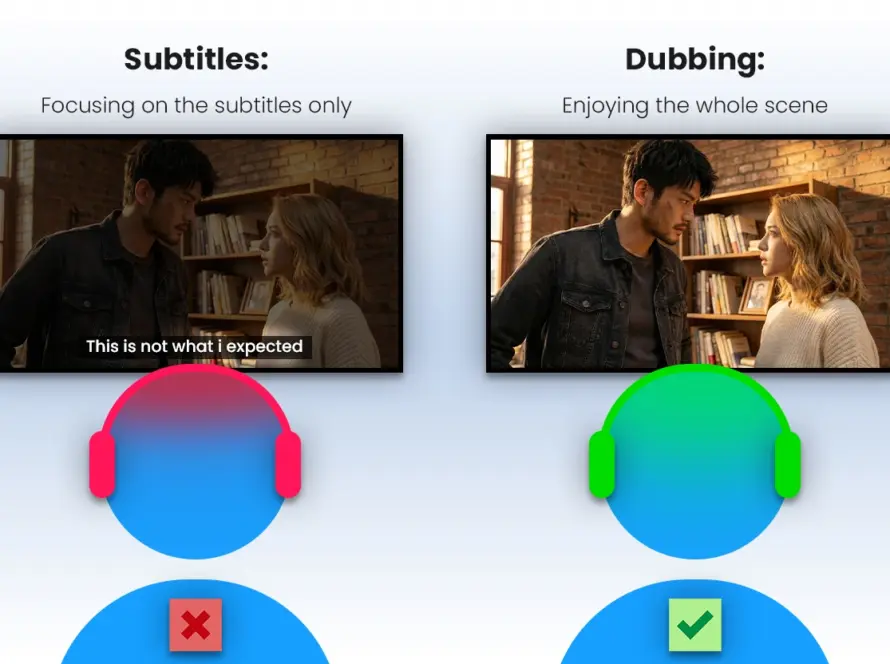
- Subtitles help viewers understand without changing the audio.
- Dubbing makes content “listen-first,” which often increases session time and retention—especially on mobile and in casual viewing contexts.
Creators miss one key point:
Localization is not a one-time project. It is a system.
If your workflow isn’t repeatable, the cost per video stays high and quality becomes inconsistent, which can harm channel trust.
2) Subtitles vs Dubbing for YouTube
Choose subtitles when:
- You want fast language expansion
- You publish frequently and need a scalable workflow
- You are testing new countries
- Your content is informational and readable on-screen
Choose dubbing when:
- Your audience prefers listening
- Your content relies on personality, storytelling, humor, emotion
- You want deeper retention in specific markets
- You want to build “local channels” or localized audience communities
Best practice for most creators:
Subtitles first → dubbing for top markets.
This is the creator version of what OTT platforms do.
3) Choosing Languages
The wrong approach:
- Choosing languages based on personal guesswork
The right approach:
use data + opportunity.
Step 1: Check YouTube Analytics by geography
Look at:
- Where you already get impressions and views
- Where watch time is rising
- Where your CPM/RPM is strong (if monetized)
Step 2: Pick a “Tier 1” language set (3–5 languages)
A common strategy is:
- Choose 1–2 “global reach” languages
- Choose 1–2 “high growth” regional languages
- Choose 1 “strategic” language where you have audience traction
Step 3: Expand in tiers
- Tier 1: 3–5 languages (subtitle-first)
- Tier 2: add 3–5 more based on performance
- Tier 3: dubbing for the top-performing markets
Important: If you publish 20 videos/month, adding 10 languages immediately multiplies your workload. Tiering keeps it sustainable.
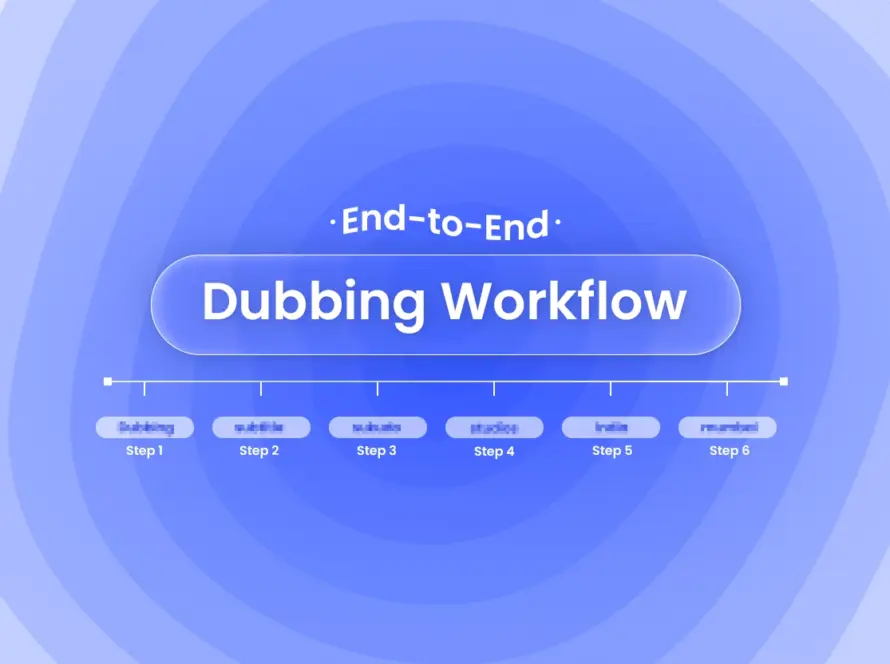
4) The YouTube Localization Workflow
Here is the workflow that scales without chaos.
Step 1: Choose videos to localize
Start with:
- Top evergreen videos (steady views)
- Videos with high retention (strong content quality)
- Videos that represent your channel identity
Avoid starting with:
- Low-retention videos
- Time-sensitive news videos
- Content that depends heavily on region-specific context (unless you can adapt it)
Step 2: Script or transcript preparation
A clean transcript improves:
- Subtitle timing
- Translation accuracy
- Dubbing adaptation quality
If the transcript is wrong, everything downstream suffers.
Step 3: Translation
- Subtitle translation should prioritize clarity and readability.
- Dubbing needs adaptation (natural tone + timing discipline).
Step 4: Proofreading + QC
For subtitles:
- fix grammar, terminology, names, punctuation
- ensure timing/segmentation rules are followed
For dubbing: - verify intent, tone, and naturalness before recording
Step 5: Timing/spotting
Professional subtitles require:
- Clean line breaks
- Reading speed controls
- Timecode accuracy
- Consistent style
Step 6: Publish
When you localize at scale:
- You need version labels (v1/v2)
- Logs for what changed
- Consistent file naming conventions
This prevents confusion later.
5) Subtitle Quality Checklist
Subtitles can help, but bad subtitles hurt trust fast.
Subtitle QC checklist
- Are lines short and readable?
- Are timecodes aligned to speech?
- Are line breaks natural?
- Is reading speed reasonable?
- Are names/terms consistent?
- Are slang and tone adapted (not literal)?
- Do subtitles avoid covering key on-screen text?
- Do punctuation and capitalization match a consistent style?
If you plan to localize seriously, you need proofreading and QC—especially for high-value languages.
6) Dubbing Workflow Checklist for YouTube Videos
Dubbing for YouTube can be done in different levels:
- Timed dub (not strict lip-sync): good balance of quality and speed
- Lip-sync dub: best for storytelling and drama-style content, but more effort
Basic YouTube dubbing workflow
- Script adaptation (for natural phrasing)
- Casting (voice aligned to your brand tone)
- Recording (consistent audio chain)
- Dialogue edit (cleanup, pacing)
- Mix and master (mobile clarity matters)
- QC (pronunciation, timing, noise, loudness)
- Delivery packaging (versioned)
What creators should demand from a vendor
- consistent voice identity (especially if you have a recognizable persona)
- clean audio and clarity
- a revision policy (how corrections are handled)
predictable turnaround time
7) Publishing & Packaging
Even creators benefit from professional delivery hygiene.
Subtitles
Common formats:
- SRT (widely used)
- VTT (web-friendly)
- TTML (often platform/OTT workflows)
For YouTube, the main need is:
- proper sync
- correct encoding
- consistent style
Dubbing audio
Define:
- final audio format (WAV/other)
- naming conventions
- folder structure per language
- versioning notes
Why it matters: if you scale to 10 languages, you will lose track without structure.
8) Measuring Results
Localization is measurable.
Key metrics to track
- Watch time by country (before vs after)
- Retention curves (where drop-offs change)
- Returning viewers (localized market adoption)
- Subscribers by geography
- RPM/CPM (if monetized)
- Comments sentiment (native feel feedback)
Time window
Give each localization experiment at least:
- 2–4 weeks for stable trends (depends on channel velocity)
Don’t judge after 48 hours unless you have massive traffic.
9) Common Mistakes
Mistake 1: Translating without proofreading
Fix: proofreading + QC is the quality floor.
Mistake 2: Localizing random videos
Fix: start with evergreen top performers and scale systematically.
Mistake 3: Too many languages too soon
Fix: tier rollout based on analytics.
Mistake 4: Dubbing without adaptation
Fix: adaptation stage before recording.
Mistake 5: No voice consistency strategy
Fix: choose stable talent and maintain reference clips and guidelines.
Mistake 6: No tracking of what changed
Fix: version control and logs, especially once you scale.
If you want to expand globally on YouTube, start with a 3-language pilot:
- Subtitles + proofreading + QC
- Optional dubbing for your top market
Share:
- Your channel niche
- Your top 5 videos
- Your top countries by watch time
We’ll recommend the most efficient language rollout plan. Contact Sukudo Studios Today!
FAQ: YouTube Localization (Subtitles + Dubbing)
Most creators should start with subtitles for breadth, then dub for the top-performing markets where watch time grows.
Use YouTube Analytics. Prioritize countries where you already get impressions/watch time and where growth or revenue potential is high.
It can, especially for storytelling and personality-driven content where listening is easier than reading.
Very. Bad subtitles reduce trust quickly. Proofreading and QC prevent grammar, timing, and consistency issues.
You can, but it’s usually inefficient. Start with evergreen top performers and scale based on results.
Not always. A timed dub is often enough. Lip-sync is more valuable for drama-style content and close-up storytelling.
SRT or VTT are most common. The key is timing accuracy, readability, and consistent style.
Use a glossary, style guide, and a repeatable workflow. For dubbing, keep stable voice talent and reference clips.
It depends on length, languages, and workflow. Subtitles are usually faster than dubbing.
A video link, transcript, target languages, delivery preferences, and a note on tone/style expectations.