If you distribute content across OTT platforms, micro-drama apps, production houses, or creator channels, you’ve probably faced the same question:
Should we dub this content, or should we subtitle it?
Both options can work. The wrong one can waste budget, slow your release, or hurt viewer experience in the first 30 seconds—especially on mobile-first formats like vertical micro-drama.
This guide gives you a simple, production-ready decision framework. It covers use cases, trade-offs, rollout strategies, and a pilot plan you can run before committing to 10+ languages.
Quick Answer
Choose dubbing when:
- Your content is dialogue-heavy (drama, romance, micro-drama, series)
- You need maximum accessibility (viewers who prefer listening over reading)
- You want a “native feel” in the target market (performance matters)
- Your growth strategy depends on retention, not just reach
Choose subtitling when:
- You need fast, wide language coverage at lower cost
- Your audience is comfortable reading subtitles (varies by market and content type)
- You’re validating demand across many regions
- You want a scalable “library expansion” strategy
- Best practice for many platforms:
Subtitles first for breadth → dubbing for top-performing markets.
1) Definitions (What People Confuse)
What is dubbing?
Dubbing replaces the original spoken dialogue with a new voice track in the target language, timed to the scene. High-quality dubbing also includes translation + adaptation, voice casting, direction, editing, mixing, and QC.
What is subtitling?
Subtitling displays translated text on-screen while the original audio remains. Professional subtitling includes accurate translation, timing/spotting, formatting, and (ideally) proofreading + QC.
Captions vs subtitles (quick clarity)
- Subtitles usually translate dialogue for people who can hear the audio.
- Closed captions / SDH include additional info like speaker IDs and sound cues (useful for accessibility).
- (Exact definitions vary by platform and region; what matters is you deliver the format your platform requires.)
2) The Real Decision Factors
Most debates about dubbing vs subtitling are subjective. In production, it’s simpler: your choice depends on these measurable factors.
Factor A: Viewer experience (reading vs listening)
- Subtitles demand reading effort.
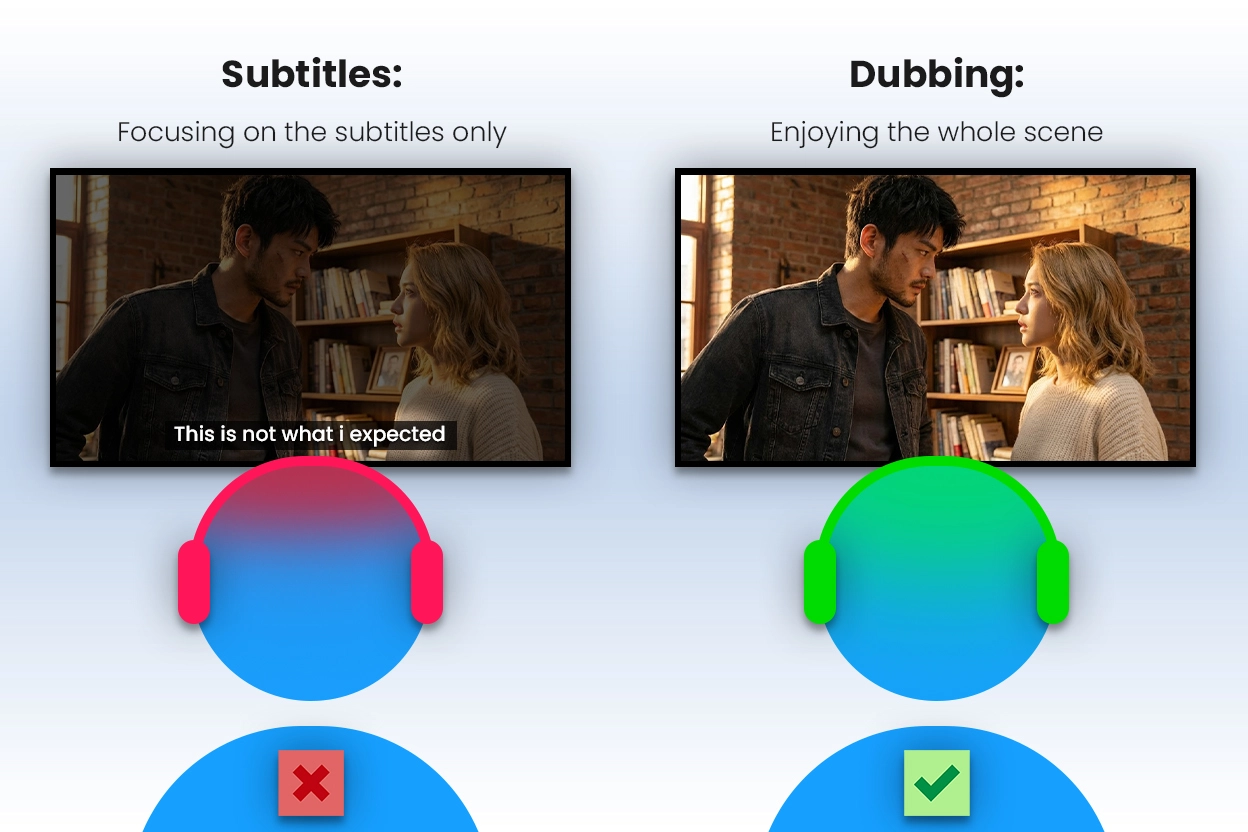
- Dubbing reduces reading load and can feel more natural—especially in fast-paced dialogue scenes.
Factor B: Speed to market
- Subtitles generally ship faster than dubbing because dubbing requires casting, recording, editing, and mixing.
Factor C: Language scalability
- Subtitles scale across many languages faster and cheaper.
- Dubbing scales well when you have a stable pipeline, but it’s heavier per language.
Factor D: Content type
- Drama, romance, micro-drama: performance matters; dubbing often has higher impact.
- Documentary/corporate: voice-over or subtitles may be sufficient.
- Tutorials and creators: subtitles might cover more markets quickly; dubbing helps when targeting major markets for deeper engagement.
Factor E: Budget and rework risk
- Dubbing cost is more sensitive to rework (late picture/script changes).
- Subtitles also suffer from late edits, but usually with less cost impact than re-recording.
3) Dubbing vs Subtitling: Comparison Table
Use this table to align internal stakeholders fast.
| Decision Factor | Dubbing | Subtitling |
| Speed to ship | Medium to slower (pipeline-dependent) | Faster |
| Languages per budget | Lower | Higher |
| Accessibility | High (listen-first experience) | Medium (requires reading) |
| “Native” feel | High when adapted and directed well | Medium; depends on translation quality |
| Risk of quality backlash | Higher if dubbing is poor | Moderate; poor subtitles still hurt but often less dramatically |
| Best for | Drama, series, micro-drama, character-driven content | Quick global reach, validation, library expansion |
| Operational complexity | Higher (casting, recording, edit, mix, QC) | Lower (translate, time, proofread, QC) |
| Most scalable strategy | Dub top markets after demand is proven | Subtitle many markets first |
Key takeaway: Subtitles maximize reach; dubbing maximizes immersion. Most serious platforms use both—sequenced properly.
4) When Dubbing Wins (Best Use Cases)
Choose dubbing when performance and retention matter more than rapid coverage.
A) Dialogue-heavy drama and series
If your content relies on emotional delivery, dubbing is usually a stronger choice—provided the adaptation and direction are professional.
B) Micro-drama / vertical drama apps
Vertical micro-drama content is watched in short bursts, often on mobile, often with quick dialogue and high emotion. A natural-sounding dub can reduce friction and improve “episode-to-episode” continuity.
C) Markets where viewers strongly prefer listening
This varies by geography and audience segment, so avoid assuming. The right approach is to validate with pilots (see Section 7).
D) Brand-driven premium content
When you want a premium perception, dubbing can deliver a “native product” feel—again, quality is non-negotiable.
Important note: Dubbing is not automatically better. Bad dubbing can perform worse than good subtitles. The bar is higher.
5) When Subtitling Wins (Best Use Cases)
Choose subtitling when speed and scale matter most.
A) Rapid global expansion (many languages quickly)
Subtitling allows you to cover many markets faster—especially useful when you have a big library.
B) Testing demand before investing in dubbing
Subtitles are an efficient “market test.” Once you see traction, you dub the winners.
C) Content types where audio replacement is not essential
For educational, documentary, corporate, or informational content, subtitles can often achieve the goal without a full dubbing pipeline.
D) When turnaround time is extremely tight
If release speed is your number-one constraint, subtitles are the simplest path to localization.
Operational advantage: Subtitles become even stronger when combined with professional proofreading + QC, because many subtitle issues are avoidable and predictable (timing, segmentation, readability).
6) The Hybrid Rollout Strategy
This is the strategy many high-output teams converge on because it balances speed, cost, and impact:
Phase 1: Subtitles for breadth
- Launch subtitles in a wide set of languages (to expand reach and measure demand).
- Ensure subtitle QC so the first impression is clean.
Phase 2: Dubbing for depth (top markets only)
- Dub the languages/regions that show strong performance.
- Standardize casting and direction so voice continuity remains consistent across episodes.
Phase 3: Optimize per content category
- Some genres get dubbed first (drama, micro-drama).
- Some genres stay subtitle-only (light content, niche categories).
This avoids the common mistake: spending dubbing budget before you know where it pays back.
7) How to Run a Pilot (Before You Commit)
If you want a decision based on evidence, not opinions, run a pilot.
Step-by-step pilot plan
- Pick 1 episode (ideally Episode 1, because it sets expectations).
- Choose 1–2 target languages (one high priority, one secondary).
- Produce:
- Professional subtitles (with proofreading + QC)
- Professional dub (with adaptation + direction + mix + QC)
- Release to a controlled segment or measure performance signals:
- Drop-off behavior (where viewers stop)
- Completion rate (episode end reach)
- Qualitative feedback (comments, support tickets)
- Rewatch/share behavior (where available)
What to score internally
- Naturalness (does it sound native?)
- Timing/sync (does it feel matched?)
- Clarity (mobile speakers + noisy environments)
- Consistency (names, terms, character tone)
- Delivery hygiene (file formats, naming, version control)
A pilot prevents expensive full-season rework.
8) Common Mistakes That Reduce ROI (Avoid These)
Mistake 1: Treating dubbing as “just translation + voices”
Dubbing needs adaptation, direction, and QC. Otherwise it sounds unnatural.
Mistake 2: Skipping subtitle QC to save time
Subtitle errors become brand damage fast—especially on OTT.
Mistake 3: Dubbing too many languages upfront
This slows delivery and spreads the budget thin. Roll out in tiers.
Mistake 4: Late picture/script changes without version control
Late changes are the biggest driver of rework cost in both dubbing and subtitles.
Mistake 5: No defined deliverables checklist
Projects fail because outputs don’t match platform requirements. Standardize early.
If you’re unsure whether to dub or subtitle, the fastest way to decide is a pilot episode.
Send us:
- 1 sample episode
- target markets/languages (priority order)
- your delivery specs (audio format, subtitles format)
We’ll recommend an approach and propose a production plan. Contact Sukudo Studios Today!
FAQ: Dubbing vs Subtitling
No. Dubbing can be more immersive, but only when adaptation, direction, and QC are strong. Subtitles can outperform poor dubbing.
Subtitling is usually faster because dubbing involves casting, recording, editing, mixing, and QC.
Subtitles generally cost less per language. Dubbing cost varies based on cast size, lip-sync requirements, revision cycles, and deliverables.
Voice-over is often used for documentaries and informational content where lip-sync is not required. It sits between dubbing and subtitles in effort and experience.
They can, especially for rapid expansion and testing. But micro-drama is fast-paced; viewers may prefer listening over reading. A pilot is the safest way to decide.
Yes, and it’s often operationally cleaner because you can keep terminology consistent through shared glossaries and style guides.
Often: subtitle many languages first → dub top-performing markets next → expand dubbing gradually with a stable pipeline.
Define deliverables, use version control, maintain style guides and glossaries, build QC gates, and run periodic continuity checks.
It depends on your platform and workflow (SRT, VTT, TTML). Use the format your platform requires, and convert with QC to avoid timing and formatting issues.
Episode count, average runtime, target languages (priority order), whether M&E/stems exist, and delivery specs. A pilot episode improves accuracy.